

(Photo Credit: Adobe Stock)
Your trip is over. The data mess is just beginning.
Co-authored by Catalin Ciobanu, David Mora-Meza and Viet-Thai Nguyen.
A trip is the unit of travel. Everywhere in the world, value for companies accumulates one trip at a time. Whether the ROI is large or small, positive or negative, one thing is clear: to understand the value of travel, we must look at individual trips.
It sounds obvious, yet in practice it is hardly ever done! Most business travel KPIs are based on transaction-level data – giant spreadsheets containing original bookings, exchanges, refunds, one-way tickets, and other fragments connected to the trips. This greatly hinders our ability to analyze trips, which begs the question:
How far is the transaction-level view from the trip-level view of travel?
To quantify how close these two views are from each other, we used a recent dataset (2024-2025) to compute:
- The ratio between the number of unique trips and the number of transactions (rows).
- The ratio between the total cost of a trip and the cost of the corresponding air ticket. This is relevant for trip approval – often done based on airfare alone.
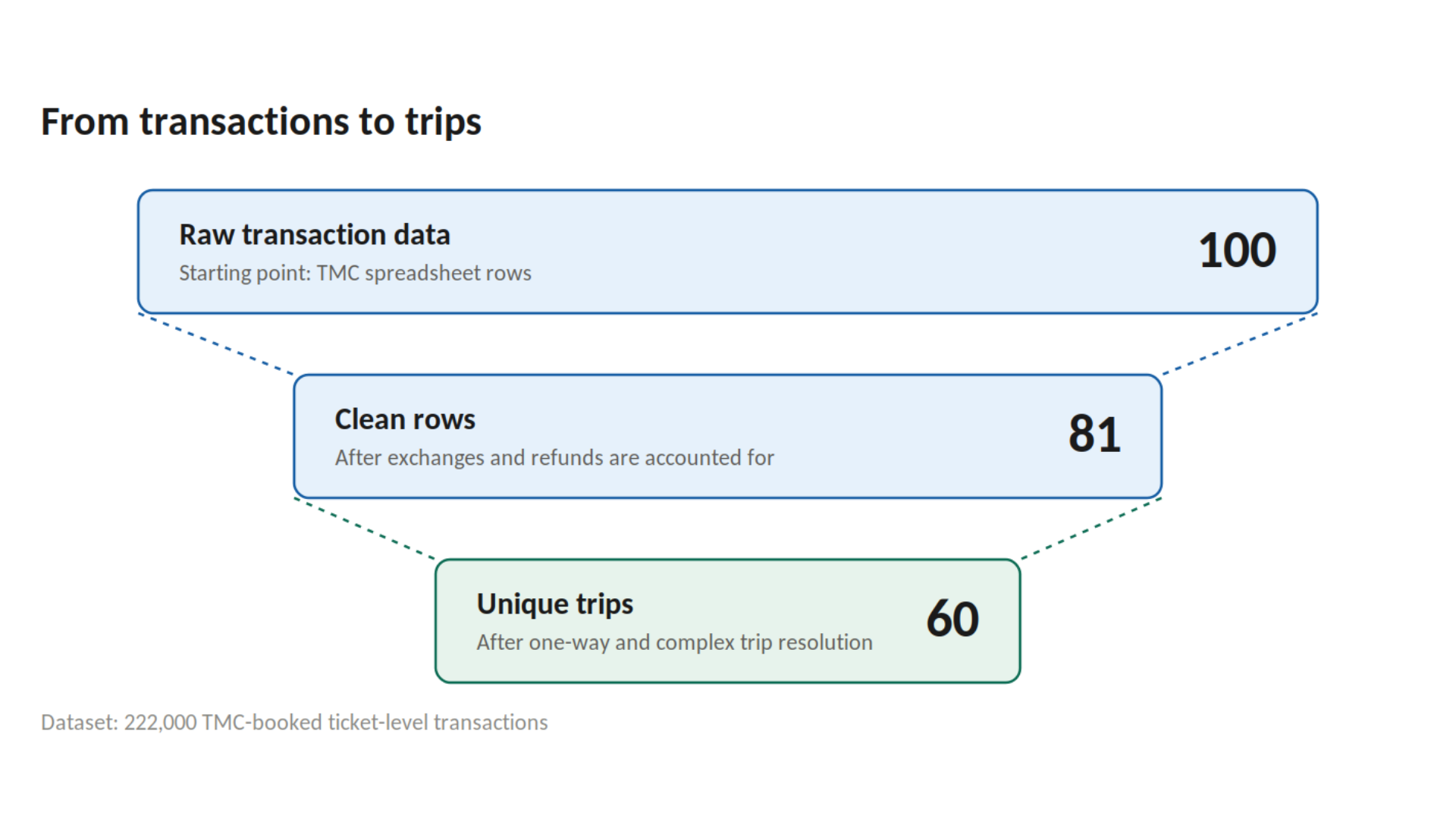
The answer to the first question is staggering: For every 100 air transaction rows, there are only about 60 unique trips.
For some corporations, it’s as low as 50 — meaning nearly half the “data” isn’t trips at all, but fragments waiting to be stitched together. Hotel bookings show the same pattern. The first chart below traces that drop, from raw rows to clean rows to unique trips.
To answer the second question, we selected a sample of trips with air transportation and a hotel stay of minimum 1 night.
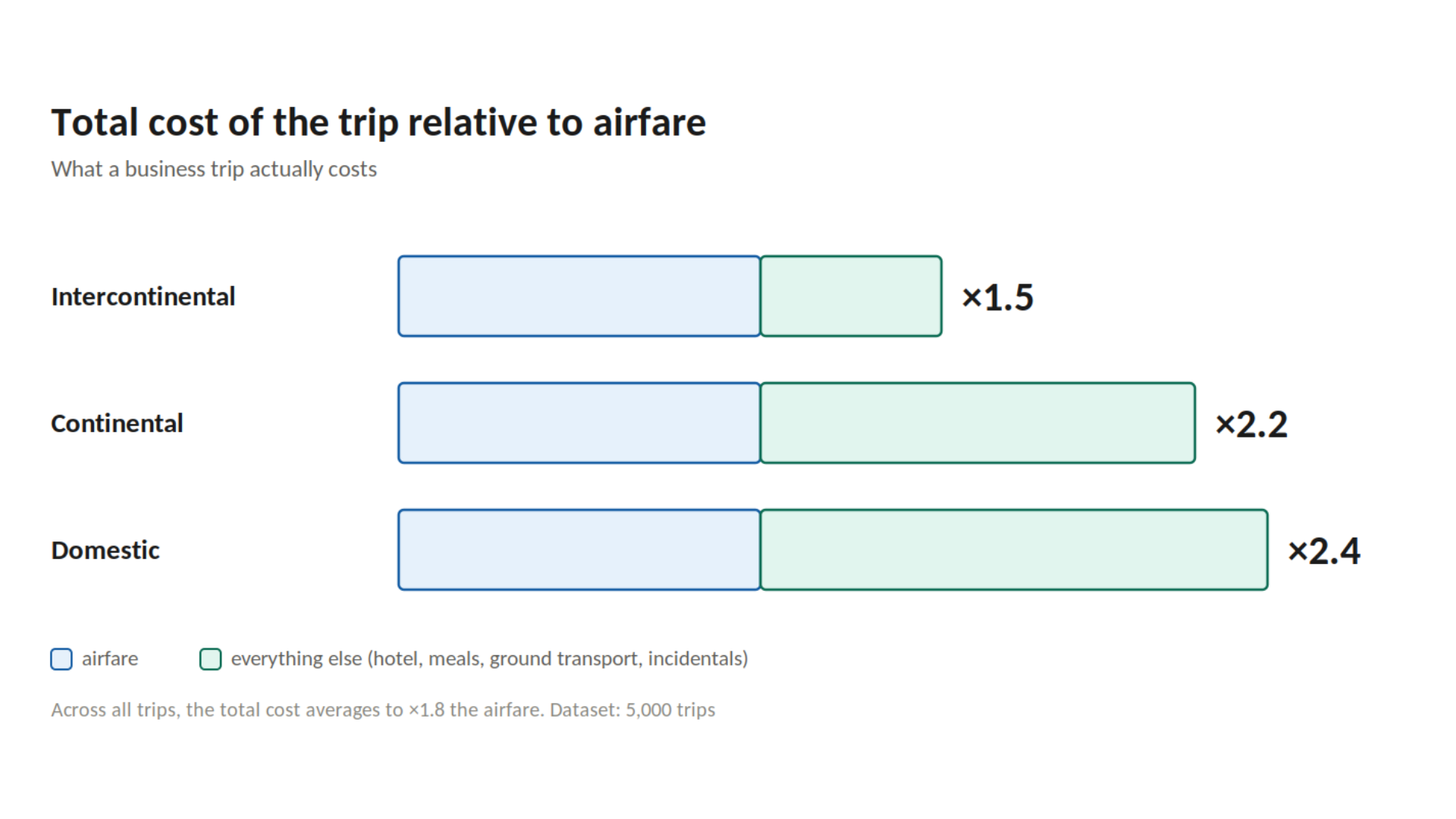
On average, the total cost of the trip is almost double (×1.8) the price of the air ticket.
The second chart below breaks that factor down by trip type. While the distribution of trip costs is wide, doubling the airfare cost is a quick rule of thumb for trip approval under limited pre-trip information.
Every travel ROI model, compliance report, and sustainability calculation built on raw transaction data inherits both gaps we have quantified here: fragmentation that obscures the trip, and a TMC-only view that misses part of trip cost. Both gaps close the moment the unit of analysis shifts from transaction to trip; measured whole, a trip becomes something you can effectively manage, not just record.
This is a natural evolution: transaction-level first, trip-level next. What other use cases for trip reconstruction do you see? Share your thoughts on LinkedIn here.