
Transient Travel and Meetings & Events: Align the Levers, Respect the Differences
Transient Travel and Meetings & Events often involve the same suppliers and the same people. That creates opportunities to coordinate, but each program also has requirements that need their own approach.
At our recent education session at GBTA + VDR + ABTA in Vienna, Areka’s Martina Eggler and Claudia Kusche explored where closer alignment can help and where Meetings & Events need distinct treatment.
Their practical framework starts with company objectives. Whether the focus is on process excellence, cost efficiency, traveler safety, or a seamless travel experience, companies must establish clear priorities and determine where travel and Meetings & Events programs should align and where distinct approaches are needed.
Start with shared objectives
Supplier strategy and cost visibility are useful starting points. Coordinating airline and hotel strategies connects the sourcing activities of both programs. Linking attendee travel costs to the meeting budget also provides a fuller picture of total event costs, including travel booked outside the event budget.
Meetings & Events have additional financial requirements. Room blocks, deposits, attrition and cancellation exposure need specific management, alongside master bills and event-level approvals. Connecting spend information supports the shared objective of controlling costs, while these commitments require distinct treatment.
Protecting people and the company calls for a similar approach. Programs should share traveler location data, alerts, assistance resources and escalation protocols. During a disruption, can the company identify, contact and support everyone affected, including guests and other non-employees?
Event teams also need attendee manifests and plans for incidents involving the venue, activities and people on site. Those requirements sit alongside the travel program’s duty-of-care arrangements.
Support the meeting’s purpose and the attendee experience
Travel decisions should support the meeting’s intended outcome. Travel time, accessibility, cost and sustainability all belong in decisions about how and where people meet. The meeting’s purpose should guide its format, venue, agenda, attendee mix and group logistics.
Delivering a consistent experience also creates connection points across policy, booking, servicing, communications and accessibility. Attendees need clear guidance from invitation through return.
Within that experience, Meetings & Events teams coordinate invitations, registration, arrival patterns and on-site information. They also manage attendee-specific needs. Connecting the programs helps these activities work together while preserving the event team’s responsibility for delivery.
Make ownership clear
Common policy principles and clear handoffs among teams provide a foundation for control and accountability. Who makes each decision? Who can commit funds? Who resolves conflicts between travel and meeting needs?
For Meetings & Events, the framework calls for an event owner with authority over design, budget, supplier commitments and attendee communications. Shared governance needs to accommodate that event-level responsibility.
Connect technology and information
Technology provides further opportunities to connect. Programs can share identity, profiles and relevant travel, payment and expense data. Coordinating integrations, AI governance and technology spending also helps teams assess how their systems work together.
Meetings & Events still need capabilities for registration, attendee communications, group bookings, on-site needs and event-level billing. Appropriate controls for guest data are part of those requirements.
The same principle applies to reporting. Connecting trip, attendee, supplier and spend data, with common definitions where possible, supports informed decisions across programs. Meetings & Events also need measures that reflect the event itself: total cost, cost per attendee, participation, outcomes and unused contractual commitments.
A starting point for reviewing your programs
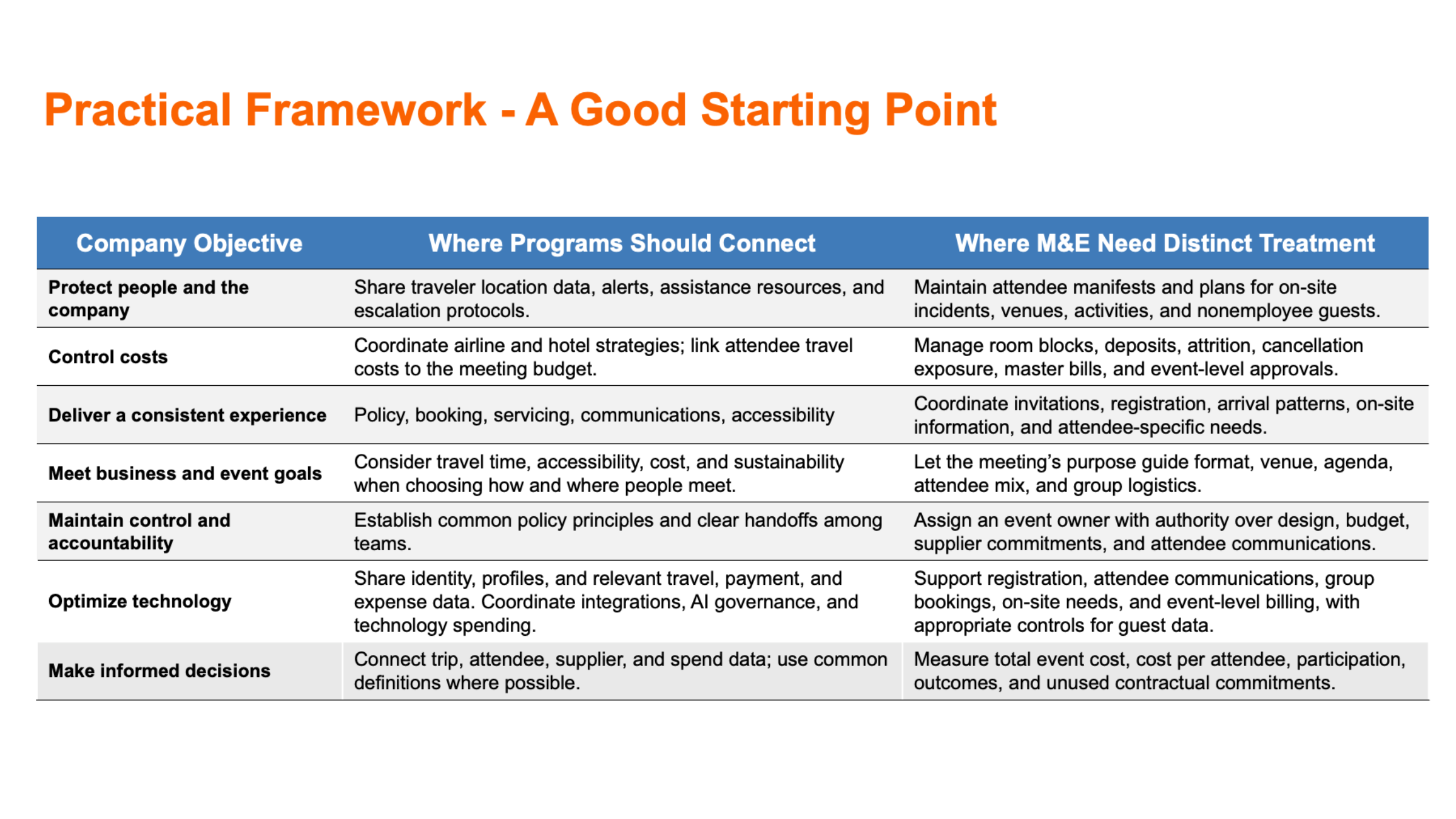
The sample framework below gives Transient Travel and Meetings & Events teams a way to review alignment against company objectives. For each objective, the discussion is specific: where should programs connect, and where do Meetings & Events need distinct treatment?
That provides a practical basis for deciding what to share, clarifying responsibilities and retaining the processes each program requires.
To discuss how this framework could apply to your organization, contact Areka.